
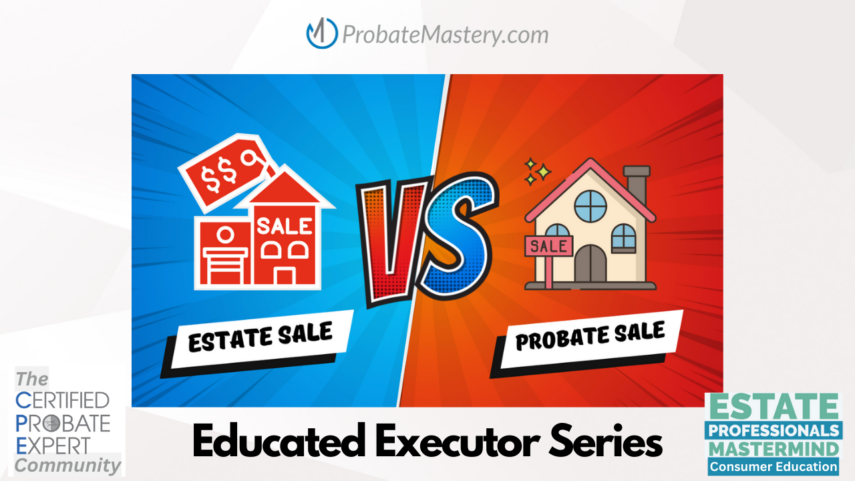
Estate Sale vs. Probate Sale: An Agent’s Guide
A nationwide guide to separating the contents sale from the real estate transaction and verifying authority before you list.
An estate sale usually sells personal belongings. A probate sale usually sells real estate during estate administration. Agents and investors need to separate the two because the signer, documents, timeline, and professionals involved may be different.
“Probate sale” is not a single nationwide procedure. Probate Mastery trains professionals in all 50 states, so this guide explains the shared business questions while treating state statutes, county rules, and court practices as the controlling local layer.
What is an estate sale?
An estate sale is an organized sale of personal property such as furniture, tools, artwork, jewelry, collectibles, appliances, and household goods. It may take place in the home, online, at an auction, or through an estate-sale company.
Estate sales are not limited to probate. A trustee, personal representative, surviving spouse, family member, or another authorized person may arrange one. They also occur when a living owner downsizes. For an agent, the key question is whether the person directing the sale has authority over the contents and has separated anything that must be retained, appraised, or distributed.
What is a probate sale?
A probate sale generally means the sale of a house, land, or other real estate connected to an estate administration. The seller is often a court-appointed personal representative, though local terms may include executor, administrator, or another fiduciary title.
A probate sale is not automatically an auction or a court-confirmed sale. The representative’s powers may come from a will, an appointment, a court order, a statute, or a combination of them. Some transactions need added notice or approval. Others can use a conventional listing and closing once authority is documented. Review how the probate process works for the broader sequence.
Estate sale vs. probate sale at a glance
| Question | Estate sale | Probate sale |
|---|---|---|
| What is sold? | Usually household contents and other personal property | Usually real estate administered through an estate |
| Who authorizes it? | The person with authority over the personal property | The personal representative or another legally authorized signer |
| Is court approval needed? | Usually not for the sale event itself, but ownership and authority still matter | Sometimes; it depends on the jurisdiction, will, appointment, and case |
| Does it transfer the house? | No | Yes, when the real estate closes under valid authority |
| Who supports the work? | Estate-sale company, auctioneer, appraiser, mover, or cleanout team | Agent, attorney, title or escrow professional, and sometimes the court |
What should an agent verify before accepting the listing?
Use Probate Mastery’s Three P Check: identify the property, confirm the representative’s power, and determine whether any additional permission is required.
- Property: Review the deed or title report. Confirm whether the real estate belongs to an estate, a trust, surviving co-owner, or another party.
- Power: Identify the person with current signing authority and the document that proves it.
- Permission: Ask the closing professional whether the sale needs beneficiary consent, notice, court approval, or another local step.
The Three P Check helps an agent avoid a common mistake: treating the most involved family member as the seller before authority is established. Heirs and beneficiaries may have rights or influence, but they do not all automatically have power to sign a listing or deed.
Can the contents be sold before the house?
Often, yes. Removing personal property can make the house easier to inspect, repair, photograph, and show. The authorized fiduciary should first identify items owned by someone else, specifically distributed under a will or trust, subject to a creditor or tax issue, valuable enough to require appraisal, or needed for estate records.
An agent can help coordinate vendors and a property-preparation schedule. The agent should not decide which possessions may be discarded or sold. Put those decisions back with the authorized representative and legal advisers.
Does every inherited house require a probate sale?
No. Real estate may pass outside estate administration when it is owned by a trust, held with survivorship rights, transferred through a valid beneficiary or transfer-on-death deed where allowed, or handled under another state procedure. Even inside probate, the representative may have authority to complete an ordinary market listing without a separate confirmation hearing.
If title is held by a trust, use the separate guide to trust sales in real estate. The deed and local closing requirements should decide which path applies, not a family’s shorthand for the situation.
How should an agent document value?
A comparative market analysis or broker price opinion often gives the fiduciary a practical, market-based pricing record. It can save the estate the cost of an appraisal when no court, statute, lender, attorney, or estate document requires one. Build the file with relevant comparable sales, property condition, repair assumptions, recommended market exposure, and the offers received.
Do not promise that a CMA will satisfy every case. Ask the representative and counsel whether a formal appraisal is required for tax reporting, a dispute, a court filing, financing, or another purpose.
Do probate properties sell for less?
Not as a rule. Price depends on condition, market exposure, financing, title readiness, approval requirements, and the seller’s goals. Clear authority, realistic preparation, and broad marketing can create ordinary market competition. Agents should price from evidence rather than assume every probate property is distressed.
Probate sale questions from agents and investors
Can an heir sign the listing agreement?
Only when that heir also has the required legal authority or the jurisdiction permits the person to act in that situation. Heir status alone does not establish signing authority.
Can a probate house be listed before probate closes?
Often, yes. The representative must first have the authority needed to list and sell, and any required notice or approval must be built into the transaction.
Is an estate-sale company a real estate broker?
Not necessarily. Estate-sale companies generally handle personal property. A licensed real estate professional handles the real estate listing unless local law provides otherwise.
Should the contents and house be marketed together?
Usually they should be treated as separate scopes, contracts, and timelines. Coordinate the schedules so the contents sale supports rather than disrupts property preparation and showings.
Know what to verify before the listing appointment
Probate Mastery’s free course gives agents and investors a practical foundation for authority, timelines, property preparation, and estate-related conversations.
Sources and nationwide practice note
The Uniform Probate Code is a model act, not a nationwide statute. States may adopt, reject, or modify its provisions, and local court procedures can add another layer. This article provides general education for real estate professionals in all 50 states, not legal or tax advice. Confirm controlling law and procedure with the appropriate attorney, court, and title professional.
About the Author

Request a Probate Lead Quote
Tell us where you work. We’ll research your market and reach out within one business day with an estimated lead count and price.